


Anterior Pelvic Herniation After Urethral Atresia: A Case Report and the Bladder Space-Occupying Hypothesis
DOI:
https://doi.org/10.14740/jmc5430Keywords:
Urethral atresia, Atrophy due to bladder dysfunction, Ureterovaginal fistula, Pelvic organ prolapse, Space-occupying lesion hypothesisAbstract
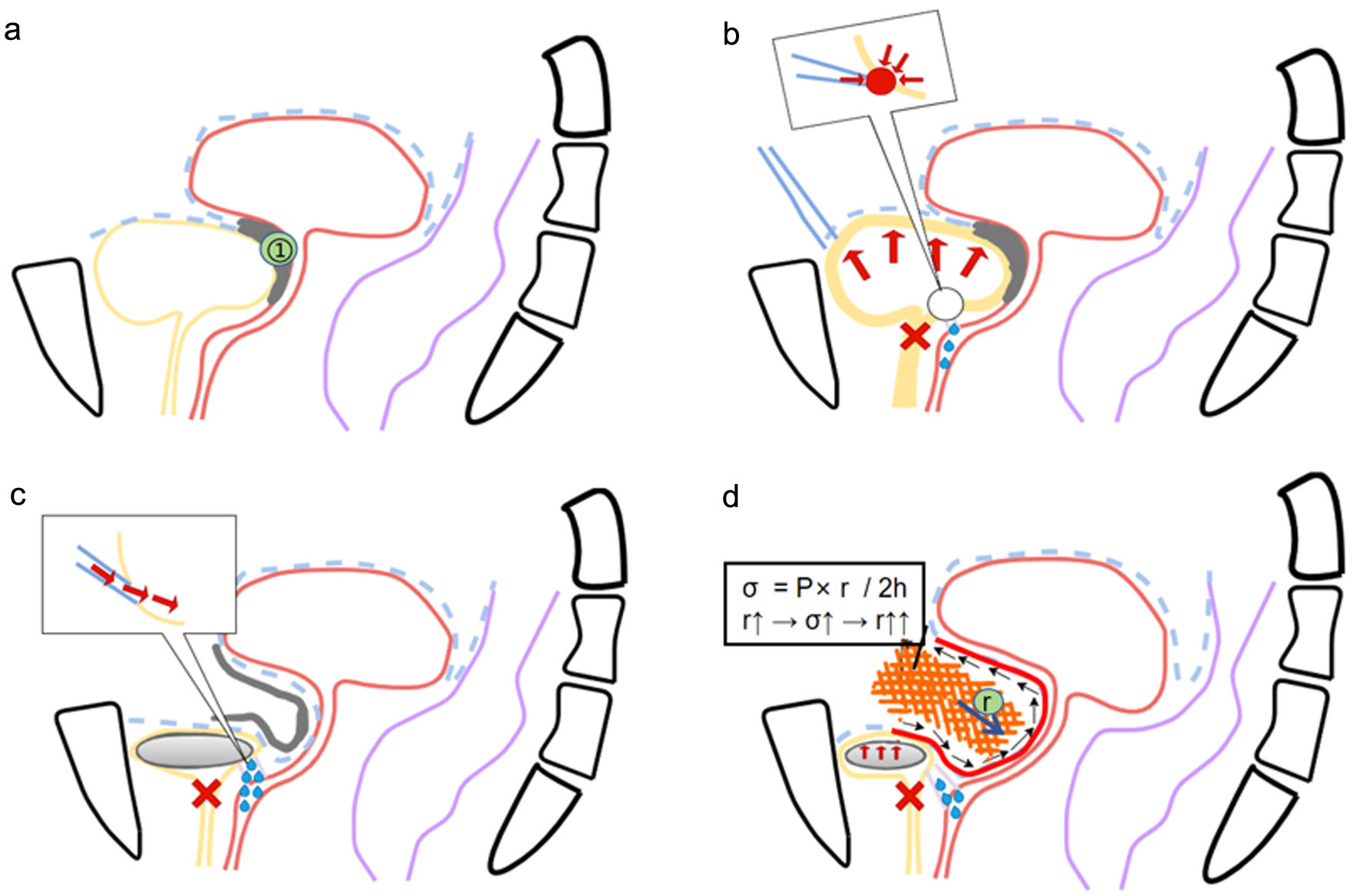
We report a case of long-standing acquired urethral atresia in an adult, accompanied by bilateral ureterovaginal fistulas, severe bladder atrophy, and an anterior pelvic hernia. We propose a hypothetical biomechanical explanation to elucidate the possible relationship among these abnormalities. We report a 71-year-old female patient who had undergone urethral tumor resection at another hospital 10 years earlier and had since experienced persistent vaginal urine leakage for more than 10 years; she presented this time with a progressively enlarging vaginal mass. The diagnosis was established based on physical examination, contrast-enhanced computed tomography (CT), and intraoperative exploration findings. Intraoperative exploration revealed complete urethral obliteration, bilateral ureterovaginal fistulae, a severely atrophic bladder remnant, and an anterior pelvic hernia containing small bowel that protruded through the vesicouterine fossa and clinically resembled a grade III cystocele. The patient underwent excision of the prolapsed vaginal mass and bilateral cutaneous ureterostomy. Based on the clinical course, imaging findings, and intraoperative observations, a three-stage biomechanical cascade hypothesis is proposed: urethral outlet obstruction may lead to elevated intravesical pressure, which in turn causes “pressure-induced perforation” at the ureterovesical junction. Direct urine diversion through the fistula results in bladder disuse atrophy. Loss of the bladder’s space-occupying function leads to reopening of the vesicouterine pouch, which then expands into an anterior pelvic hernia under repeated intra-abdominal pressure. To our knowledge, acquired urethral atresia with bilateral ureterovaginal fistulas in adults has not been previously reported. Although this hypothesis still requires further clinical and finite element modeling studies for precise validation, the proposed “bladder space-occupying effect hypothesis” may provide, in the future, a theoretical framework for subsequent research on atypical pelvic organ prolapse after long-term bladder disuse.
Published
Issue
Section
License
Copyright (c) 2026 The authors

This work is licensed under a Creative Commons Attribution 4.0 International License.