

Omental Serous Cystadenofibroma Mimicking Disseminated Malignancy: A Rare Pathology
DOI:
https://doi.org/10.14740/jmc5316Keywords:
Cystadenofibroma, Ovarian neoplasms, Omental mass, Benign ovarian tumors, Multicentric lesionsAbstract
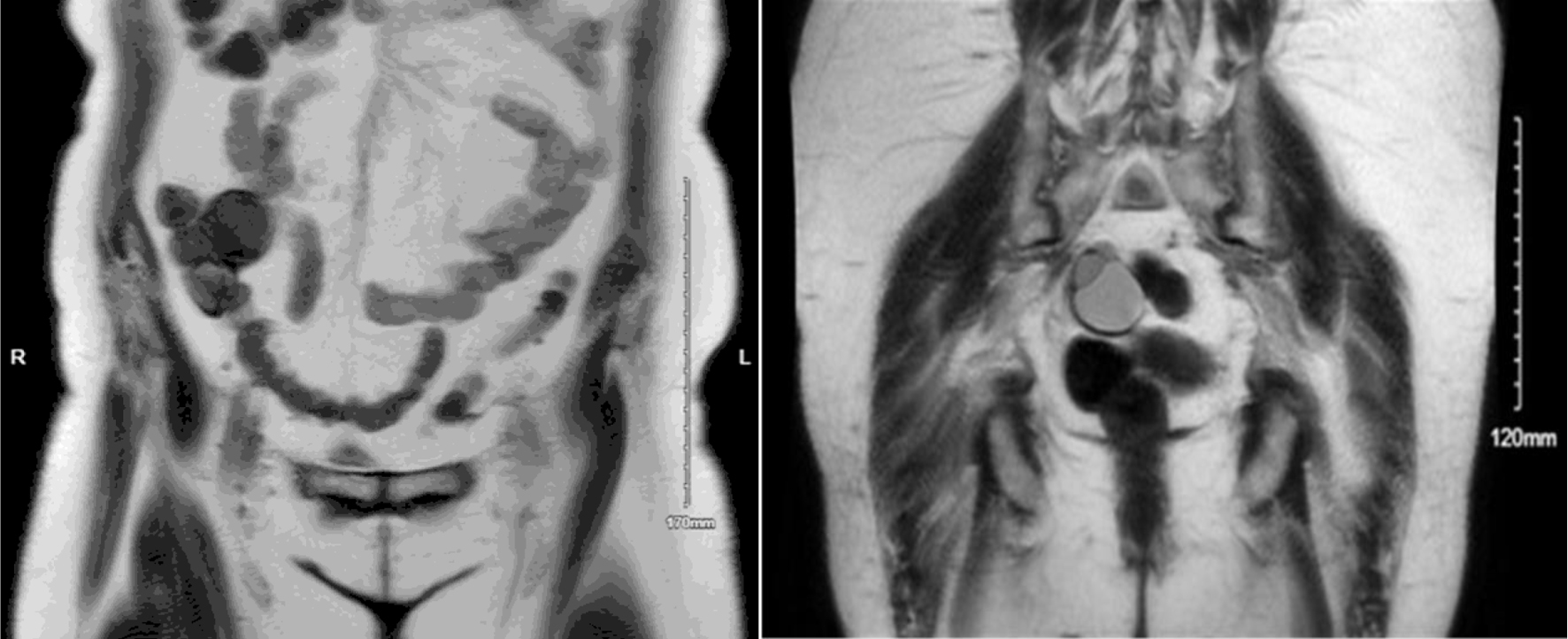
Serous cystadenofibromas are rare benign epithelial ovarian tumors. They account for < 2% of benign ovarian tumors and typically affect individuals aged 15–65. In rare cases, these tumors present with scattered pelvic lesions resembling malignant dissemination. A 68-year-old female presented with pelvic pain. Pelvic sonogram revealed a 6 cm mass anterior to the cecum and bilateral cystic ovarian lesions measuring approximately 5 and 4 cm on the right and left, respectively. Subsequent pelvic magnetic resonance imaging (MRI) confirmed multicystic complex ovarian masses and a 6 cm multicystic mass along the cecum. Colonoscopy revealed no intrinsic rectal or sigmoid disease. She was subsequently referred to minimally invasive gynecology surgery and colorectal surgery for further management. Tumor markers and a ROMA panel were within normal limits. Computed tomography (CT) of abdomen/pelvis redemonstrated a multilobulated, cystic mass in the right lower quadrant with adjacent satellite lesions and bilateral cystic adnexal masses. Surgical intervention included robotic-assisted total laparoscopic hysterectomy, bilateral salpingo-oophorectomy, extensive lysis of adhesions, and infracolic omentectomy. Intraoperative findings revealed dense adhesions between the omentum, right adnexa, pelvic sidewall, and cecum. Frozen section revealed bilateral ovarian cystadenofibroma and omental tissue with benign cystic lesions resembling serous cystadenofibroma. Postoperatively, the patient had an uneventful recovery. Serous cystadenofibromas are associated with a favorable prognosis after complete resection of the tumor. The use of preoperative imaging and intraoperative frozen sections can help guide appropriate surgical management. However, these tumors pose diagnostic challenges due to their complex nature of adnexal masses with solid and cystic elements, often leading to misdiagnosis of malignancy. In rare cases, the presence of multiple lesions may be more consistent with multicentric development or independent primary lesions rather than true dissemination. Although malignancy must be carefully excluded, disseminated benign serous cystadenofibroma implants may radiologically and intraoperatively mimic peritoneal carcinomatosis, underscoring the importance of a broad differential diagnosis to guide intraoperative judgment and avoid overtreatment.
Published
Issue
Section
License
Copyright (c) 2026 The authors

This work is licensed under a Creative Commons Attribution 4.0 International License.