

Long-Term Disease-Free Survival After Sorafenib-Combined Chemotherapy for Refractory Metastatic Testicular Germ Cell Tumor: A Five-Year Follow-Up
DOI:
https://doi.org/10.14740/jmc5235Keywords:
Non-seminomatous germ cell tumor, Precision oncology, KRAS amplification, Long-term survivalAbstract
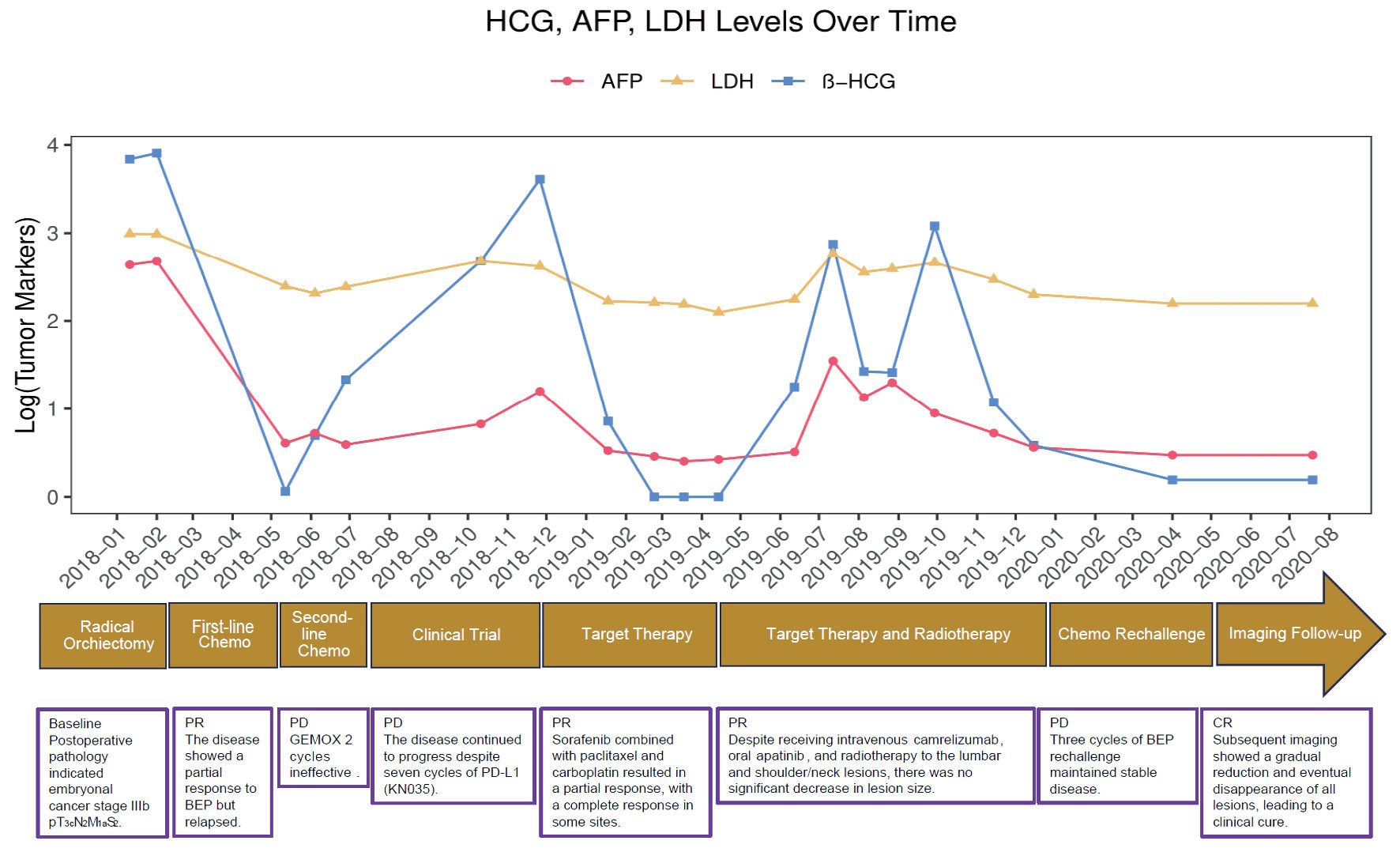
The management of late-stage refractory metastatic non-seminomatous germ cell tumor (NSGCT) remains a significant challenge in oncology. While first-line BEP (bleomycin, etoposide, cisplatin) chemotherapy achieves high cure rates in most patients, those who progress after multiple lines of therapy have a poor prognosis and limited treatment options, highlighting a critical gap in effective treatment decision-making for advanced disease. This previously reported case is an example of precision medicine and also demonstrates that the therapeutic effect is not transient but can be sustained long term, as shown by our 5-year follow-up. This 21-year-old man with widely metastatic NSGCT initially underwent orchiectomy followed by BEP chemotherapy, which achieved only a partial response. He then experienced rapid progression with new lung and brain metastases that were unresponsive to second-line GEMOX (gemcitabine + oxaliplatin) chemotherapy and a programmed death-ligand 1 (PD-L1) blockade clinical trial. When treatment options were exhausted, comprehensive molecular profiling of a new lung lesion identified 22 oncogenic alterations, including Kirsten rat sarcoma viral oncogene (KRAS) amplification. Guided by a molecular tumor board (MTB) recommendation, an off-label regimen of carboplatin, paclitaxel, and sorafenib (CPS) was initiated, targeting the MAPK pathway. The tumor again developed resistance to CPS, prompting a rational BEP rechallenge that resulted in disease stabilization and ultimately a durable long-term remission. At the 5-year follow-up in July 2025, the patient remains disease-free with a normal quality of life. We present this N-of-1 case to illustrate how molecularly guided post-resistance treatment can inform therapeutic decision-making in advanced disease. Tumors are highly complex, and gene-cancer interaction is still being elucidated. In this context, key learning points from this case include: 1) the critical role of iterative molecular profiling and MTB guidance in identifying actionable targets when standard options are exhausted; 2) the potential value of rational drug rechallenge informed by the evolving “tumor ecology;” and 3) the necessity of long-term follow-up to link treatment responses with biomarkers, allowing N-of-1 learning that may offer a template for personalized management in similarly challenging cases.
Published
Issue
Section
License
Copyright (c) 2026 The authors

This work is licensed under a Creative Commons Attribution 4.0 International License.