Aberrant Right Subclavian Artery Causing Dampening of the Right Radial Arterial Cannula Tracing Following Transesophageal Echocardiography Probe Insertion
DOI:
https://doi.org/10.14740/jmc5322Keywords:
Congenital heart disease, Vascular ring, Aberrant right subclavian arteryAbstract
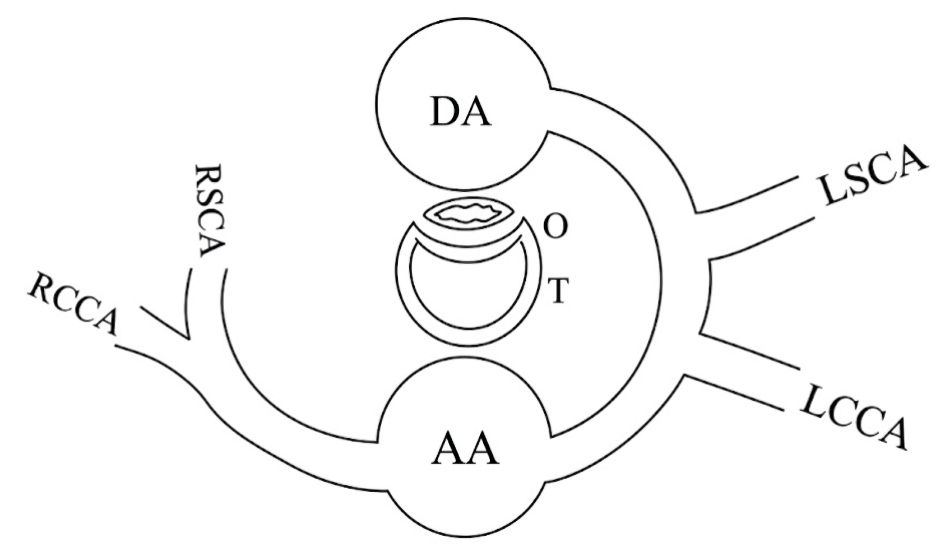
An aberrant right subclavian artery (ARSA) is the most common congenital anomaly of a left aortic arch. Given the anatomical course of the ARSA, it generally remains asymptomatic throughout life without hemodynamic or respiratory effects. We report the intraoperative diagnosis of ASRA during surgery for congenital heart disease when there was dampening of the waveform from the right radial arterial cannula during transesophageal echocardiography (TEE) probe placement. The subsequent identification of ARSA highlights the importance of considering vascular anomalies in cases of unexplained intraoperative hemodynamic monitoring abnormalities during and after TEE probe insertion.
Published
Issue
Section
License
Copyright (c) 2026 The authors

This work is licensed under a Creative Commons Attribution 4.0 International License.