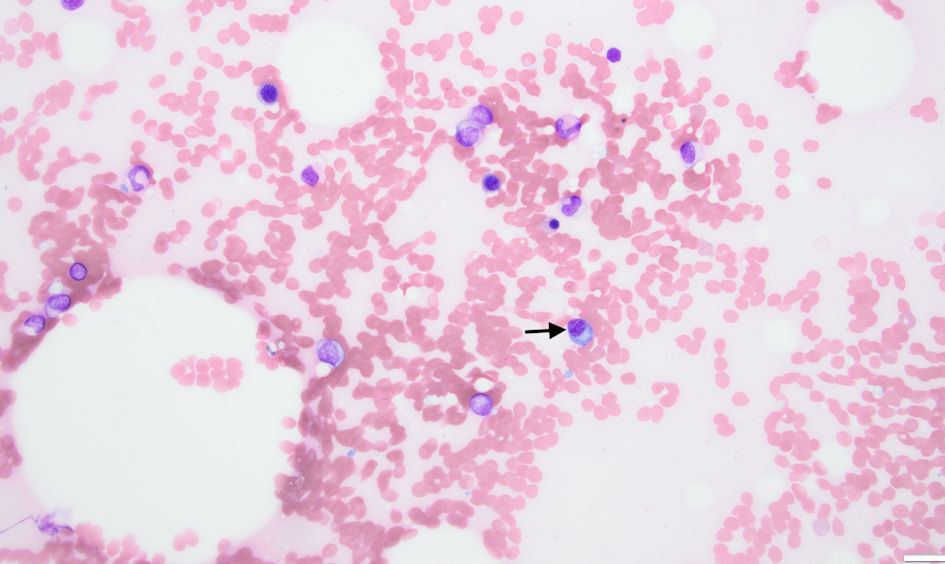
↓ Figure 1. Bone marrow biopsy (with Wright-Giemsa staining) at initial diagnosis of high-risk MGUS demonstrating approximately 6% plasma cells (black arrow), consistent with high-risk MGUS. MGUS: monoclonal gammopathy of undetermined significance.
| Journal of Medical Cases, ISSN 1923-4155 print, 1923-4163 online, Open Access |
| Article copyright, the authors; Journal compilation copyright, J Med Cases and Elmer Press Inc |
| Journal website https://jmc.elmerpub.com |
Case Report
Volume 17, Number 10, October 2026, pages 604-611
Hyperviscosity Syndrome as a Rare Presentation of Immunoglobulin G Kappa Smoldering Multiple Myeloma Successfully Treated With Daratumumab
Figures
Tables
| Date | Findings |
|---|---|
| IgG: immunoglobulin G; FLC: free light chain. | |
| June 2018 | IgG kappa paraprotein 1.18 g/dL; FLC ratio 3.39 |
| August 2020 | Bone marrow biopsy: 6% plasma cells |
| 2020–2025 | Progressive increase in M-protein and FLC ratio |
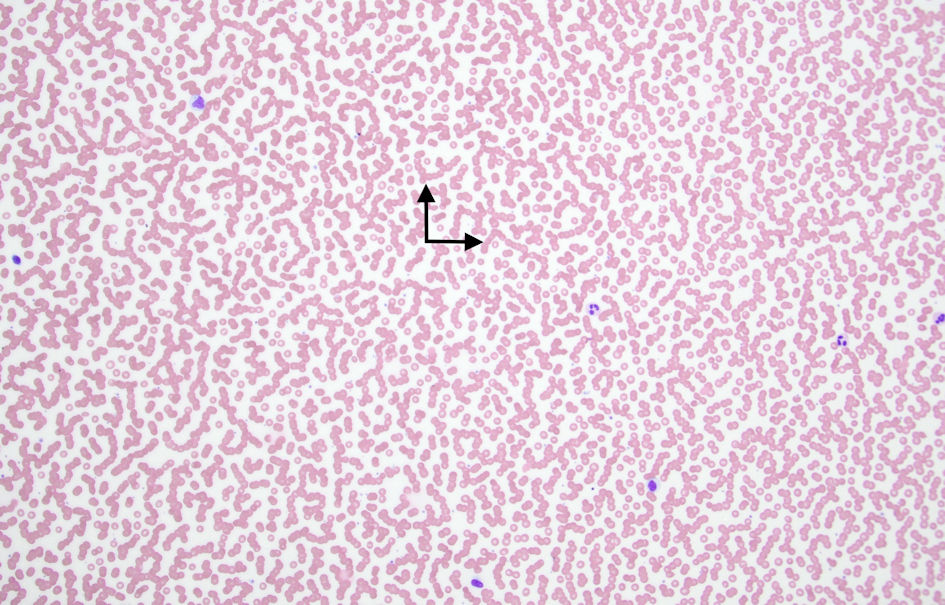
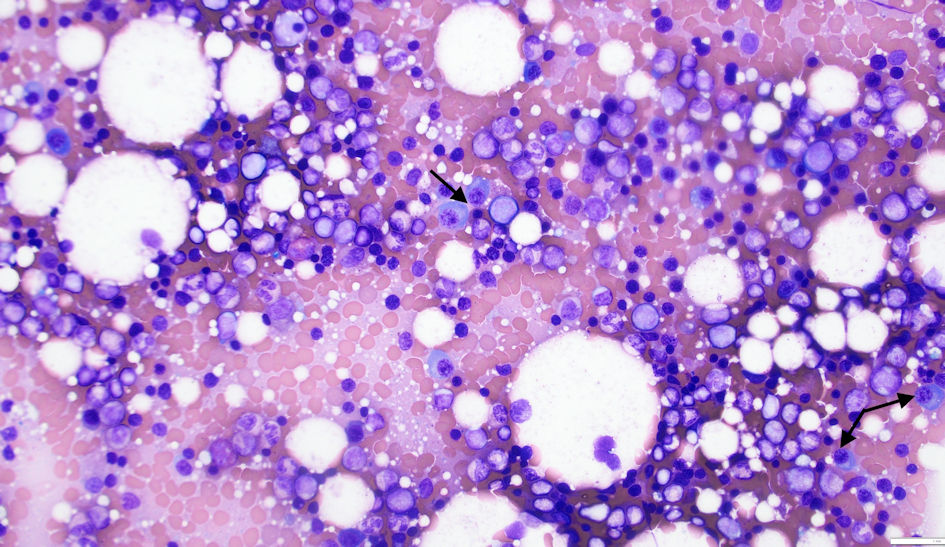
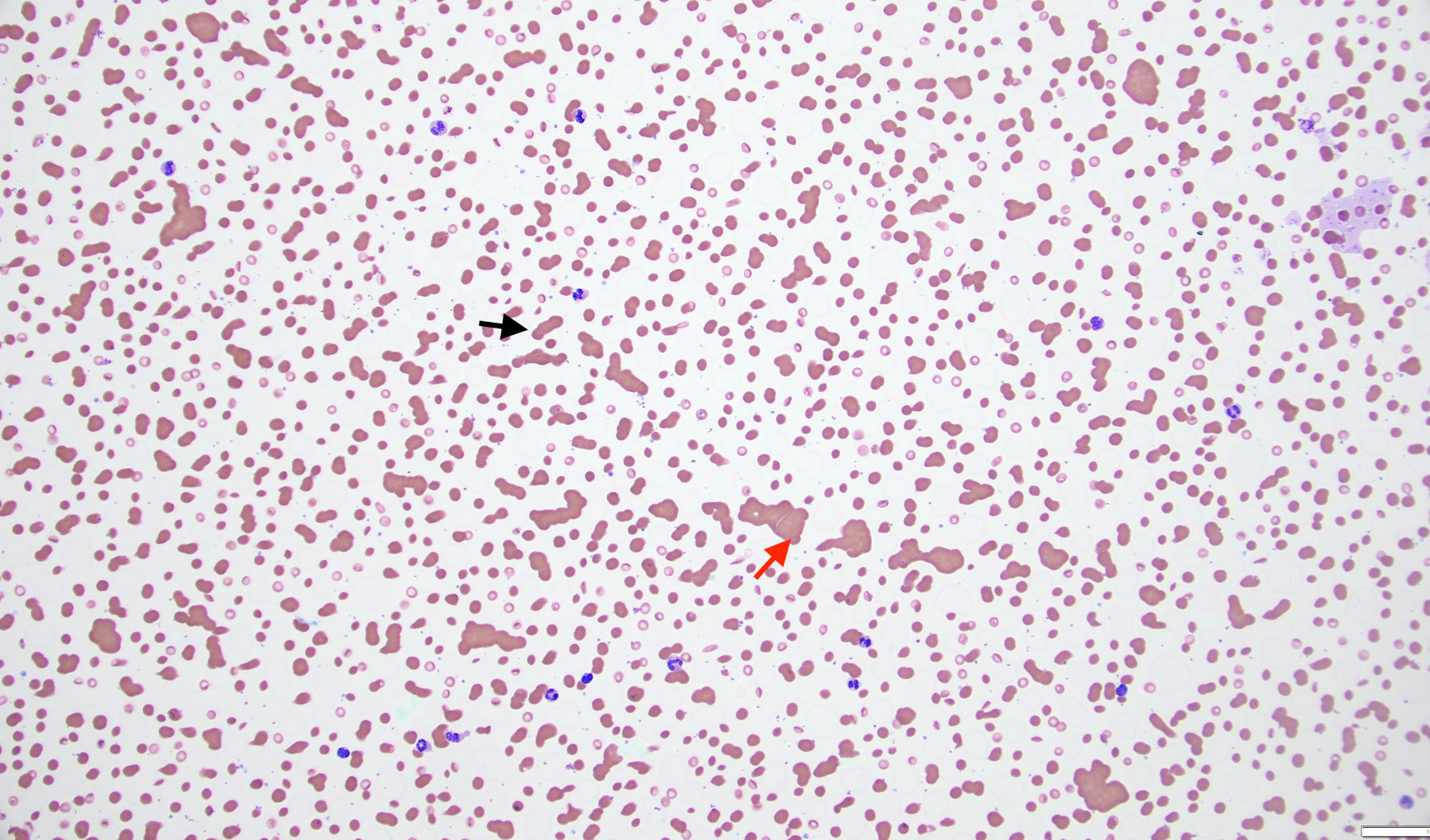
| June 2025 | Bone marrow biopsy: 10% plasma cells; rouleaux formation |
| January 2026 | Gross hematuria requiring bladder irrigation |
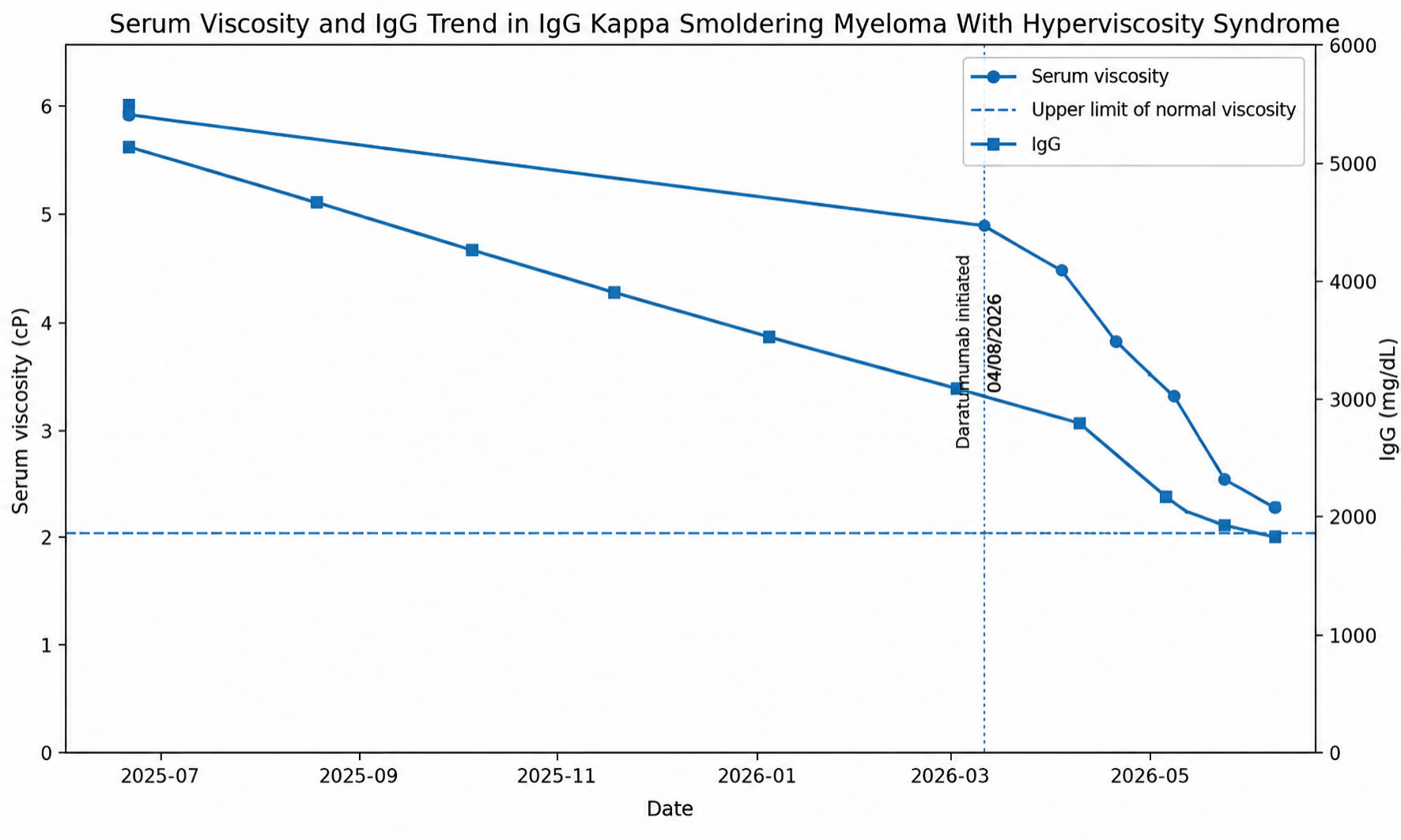
| February 2026 | Serum viscosity 5.7 centipoise |
| March 2026 | Retinal hemorrhage and epistaxis |
| April 2026 | Daratumumab initiated |
| June 2026 | Serum viscosity improved to 2.2 |
| Date | WBC (× 103/µL) | Hemoglobin (g/dL) | Platelets (× 103/µL) | IgG (mg/dL) | M-protein (g/dL) |
|---|---|---|---|---|---|
| WBC: white blood cell; IgG: immunoglobulin G. | |||||
| August 2020 | 3.2 | 13.8 | 121 | — | 2.21 |
| August 2023 | 3.3 | 12.6 | 148 | — | 2.51 |
| April 2024 | 3.5 | 13.3 | 120 | — | 2.68 |
| June 2025 | — | — | — | 5,463 | 3.01 |
| January 2026 | 2.5 | 12.2 | 105 | — | — |
| April 2026 | 3.0 | 12.7 | 114 | — | — |
| May 2026 | 3.1 | 13.7 | 118 | — | 2.26 |
| June 22026 | 5.4 | 15.2 | 141 | 2,653 | 1.35 |
| Date | Serum viscosity (cP) |
|---|---|
| cP: centipoise. | |
| February 18, 2026 | 5.7 |
| Treatment initiated on April 8, 2026 | |
| April 20, 2026 | 4.5 |
| April 27, 2026 | 3.7 |
| May 4, 2026 | 3.4 |
| May 18, 2026 | 2.5 |
| June 1, 2026 | 2.2 |
| Underlying disorder | Predominant paraprotein/cause | Frequency of HVS | Typical serum viscosity threshold | Comments |
|---|---|---|---|---|
| HVS: hyperviscosity syndrome; IgG: immunoglobulin G; IgA: immunoglobulin A; IgM: immunoglobulin M; PCL: plasma cell leukemia; MGUS: monoclonal gammopathy of undetermined significance; AML: acute myeloid leukemia; CML: chronic myeloid leukemia; WBC: white blood cell; cP: centipoise; SLiM-CRAB: ≥ 60% clonal bone marrow plasma cells, light chain ratio ≥ 100, magnetic resonance imaging focal lesions, hypercalcemia, renal insufficiency, anemia, and bone lesions. | ||||
| Waldenstrom macroglobulinemia | IgM monoclonal protein | Most common cause | Often > 4 cP (may occur at lower levels) | IgM is pentameric and remains largely intravascular, making it highly viscosity-inducing. Approximately 10–30% of patients develop symptomatic HVS during the disease course. |
| Multiple myeloma (IgA) | IgA monoclonal protein | Common among myeloma-associated HVS | Usually > 4–5 cP | IgA tends to form dimers and polymers, increasing serum viscosity despite lower concentrations than IgG. |
| Multiple myeloma (IgG) | IgG monoclonal protein | Uncommon | Usually > 5–6 cP | Most cases occur with very high IgG concentrations. IgG3 has the greatest tendency toward self-aggregation and hyperviscosity. |
| PCL | High circulating plasma cell burden with IgG or IgA paraproteinemia | Uncommon but well recognized | Variable | Hyperviscosity results from both markedly elevated monoclonal protein levels and circulating plasma cells. Patients often present with aggressive disease and extensive extramedullary involvement. |
| Smoldering multiple myeloma | Usually IgG or IgA | Extremely rare | Variable | Symptomatic HVS without SLiM-CRAB criteria is exceptional. The present case represents this rare presentation. |
| MGUS | Low-level monoclonal protein | Very rare | Rarely clinically significant | Usually insufficient paraprotein burden to produce symptomatic HVS. |
| Cryoglobulinemia | Cryoglobulins | Uncommon | Not serum viscosity dependent | Increased viscosity occurs primarily at low temperatures due to protein precipitation rather than absolute paraprotein concentration. |
| Polycythemia vera | Increased erythrocyte mass | Uncommon | Hematocrit > 60–65% | Hyperviscosity results from increased cellular mass rather than paraproteins. |
| Leukostasis (AML/CML) | Extreme leukocytosis | Rare | WBC typically > 100–300 × 109/L | Symptoms result from impaired microvascular flow caused by circulating leukemic blasts rather than serum protein abnormalities. |
| CRAB feature | Definition (IMWG criteria) | Clinical significance |
|---|---|---|
| CRAB: hypercalcemia, renal insufficiency, anemia, and bone lesions; IMWG: International Myeloma Working Group; CT: computed tomography; PET/CT: positron emission tomography/computed tomography. | ||
| C: hypercalcemia | Serum calcium > 11 mg/dL or > 1 mg/dL above the upper limit of normal | Indicates increased osteoclastic bone resorption due to active myeloma |
| R: renal insufficiency | Serum creatinine > 2 mg/dL or estimated creatinine clearance < 40 mL/min | Reflects myeloma-related kidney injury, often from light chain nephropathy |
| A: anemia | Hemoglobin < 10 g/dL or > 2 g/dL below the lower limit of normal | Results from bone marrow infiltration and impaired erythropoiesis |
| B: bone lesions | One or more osteolytic lesions identified on skeletal survey, CT, or PET/CT | Represents myeloma-related bone destruction and skeletal involvement |